
The President of El Salvador, Nayib Bukele, cancelled the commemoration of the Chapultepec Peace Accords successfully led by the UN in 1992, which put an end to a 12-year civil war that left more than 75,000 dead in the Central American country.
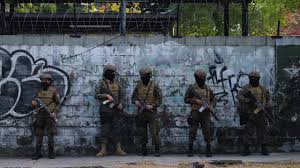
Human rights organisations, victims of the war, opposition groups, intellectuals and ex-guerrillas have taken a stand against the Salvadoran president’s recent remarks about the Peace Accords signed 29 years ago.
Outrage erupted in El Salvador on the 16th of January this year when, for the second year in a row, the president refused to commemorate the signing of the Peace Accords. Moreover, he declared the Peace Accords a farce, a work of the elites and a pact between the corrupt. For Bukele, the signing of the peace agreements did not represent any improvement for the population in their most basic rights but rather translated to a new a phase of increased corruption, social exclusion and fraudulent enrichment of the signatory sectors – referring to members of the government at the time and the Farabundo Marty National Liberation Front (FMLN).
Following his statement, a group of social organisations and victims of the armed confrontation called on Bukele to respect the accords and maintain the government’s commitment to human rights, while a hundred Salvadoran and foreign academics published a letter rejecting the president’s statements and demanding respect for the truth and historical memory.
Bukele had already created a political storm in El Salvador by preventing the unblocking of military files related to the El Mozote Massacre in direct contravention of a court order to inspect the files as part of the judicial process intended to shed light on the massacre that took place there.
Former guerilla members of the People’s Revolutionary Army (ERP), one of the groups close to the FMLN, have also criticised Bukele. Very few families in this country escaped without being injured, directly involved or in some way touched by the drawn-out confrontation. By making these denialist statements, the president is again creating division in the country, when the Peace Accords are the achievement of the entire Salvadoran society, not just the political parties.
But Bukele’s attempts to erase others have worked for his political career in the past, and he has stated he intends to win at the legislative and municipal elections in February. That is his goal, as it was the goal of all the politicians that preceded him. Politicians who no longer applaud him but are a burden to him, and his strategy is to erase them at the ballot box and from the memory of all Salvadorans.
_____
Aquest apunt en català / Esta entrada en español / Post en français


 The coronavirus pandemic has forced criminal organisations in Latin America to make various internal changes. These adjustments stem from a desire to maintain their illicit operations despite the inconveniences: the trafficking of drugs and contraband, extortion and controlling the passage of migrants across borders. Their activities have been complicated by increased police checks and a lack of human activity.
 The arrival of the coronavirus pandemic in the United Stated prompted increased sales of all types of arms, even leading to queues outside some shops.[1] Many of the buyers say they need to feel safe during the lockdown, which is forcing them to stay at home, sometimes alone. The demand for weapons has been largely non-specific. Customers want almost any type of weapon they can use to defend themselves; this in itself is unusual because, typically, people who buy arms have a specific kind of weapon in mind.
 Ransomware attacks targeting network-attached storage devices (NAS) have exponentially increased in recent months.
 With the end-of-year 2019 Black Friday and Cyber Monday sales behind us, the company
  In October 2019, more than 400 experts from law enforcement, the private sector, and academia gathered at
  Among today’s many technological advancements, 5G (fifth-generation wireless network) is among the ones that will have the most impact on citizens. It offers two significant improvements in data transmission: more volume and more speed. These enhancements to the current network could have a significant effect on both the public and private sectors.
 An emerging reality over recent years throughout Europe is the arrival of foreign minors (MENA). These are foreign minors under the age of eighteen who are nationals of a non-EU state who arrive in European territory without a responsible adult or who abandon them once they are here.